A single "In English" page is not enough
Does your association's website handle multilingualism by adding a single page called "In English"? Has this one page been tasked with summarising everything the association does? Often such a page is either very long, out of date, or both.
Another common solution is to embed a Google Translate widget on the site, which automatically translates the page content into the selected language. This is also not an ideal solution. Translation quality varies, and you have no control over what gets translated or how. Translated content is also not visible to search engines, so an English-speaking visitor won't find your site through a search engine when searching in English.
Both solutions also have an accessibility issue that is not always obvious. Every webpage has a lang attribute in its source code that tells the browser and screen reader what language the page content is written in. On a Finnish-language website, this is typically set to "fi". When the content of a single "In English" page is in English but the lang attribute is still "fi", the screen reader tries to read the English text using Finnish pronunciation rules. The result is practically unusable for a screen reader user. In the case of the Google Translate widget, the situation is the same, as the widget only translates the visible text content and does not change the page's lang attribute.
What does a proper multilingual website look like?
In a properly multilingual website, every language version is its own independent version of each page. In practice this means that, for example, an association's homepage exists in both Finnish and English, each with its own URL. The Finnish version might be found at yhdistys.fi/fi and the English version at yhdistys.fi/en.
When multilingualism is implemented this way, every page has the correct lang attribute for its own language version. Screen readers can read each page in the correct language, and search engines index each language version separately. This means an English-speaking visitor can find your association directly through a Google search in English, rather than having to navigate first to the Finnish-language site and then search for a translation page.
The site's navigation, buttons, and other interface text are also translated for each language. The experience for the visitor is seamless, and they don't have to jump between languages while browsing.
Modern content management systems, such as Kirby, which I introduced in an earlier post, support this kind of multilingualism out of the box. Moving between language versions in the admin panel is straightforward, and metadata that doesn't differ between language versions only needs to be defined once.
AI as a translation assistant
It's understandable that not everyone has the time and resources to translate every page, article, or other publication on an association's website. Traditionally, translation has meant either hiring a professional translator or spending many hours on the work yourself. AI has, however, significantly changed this dynamic.
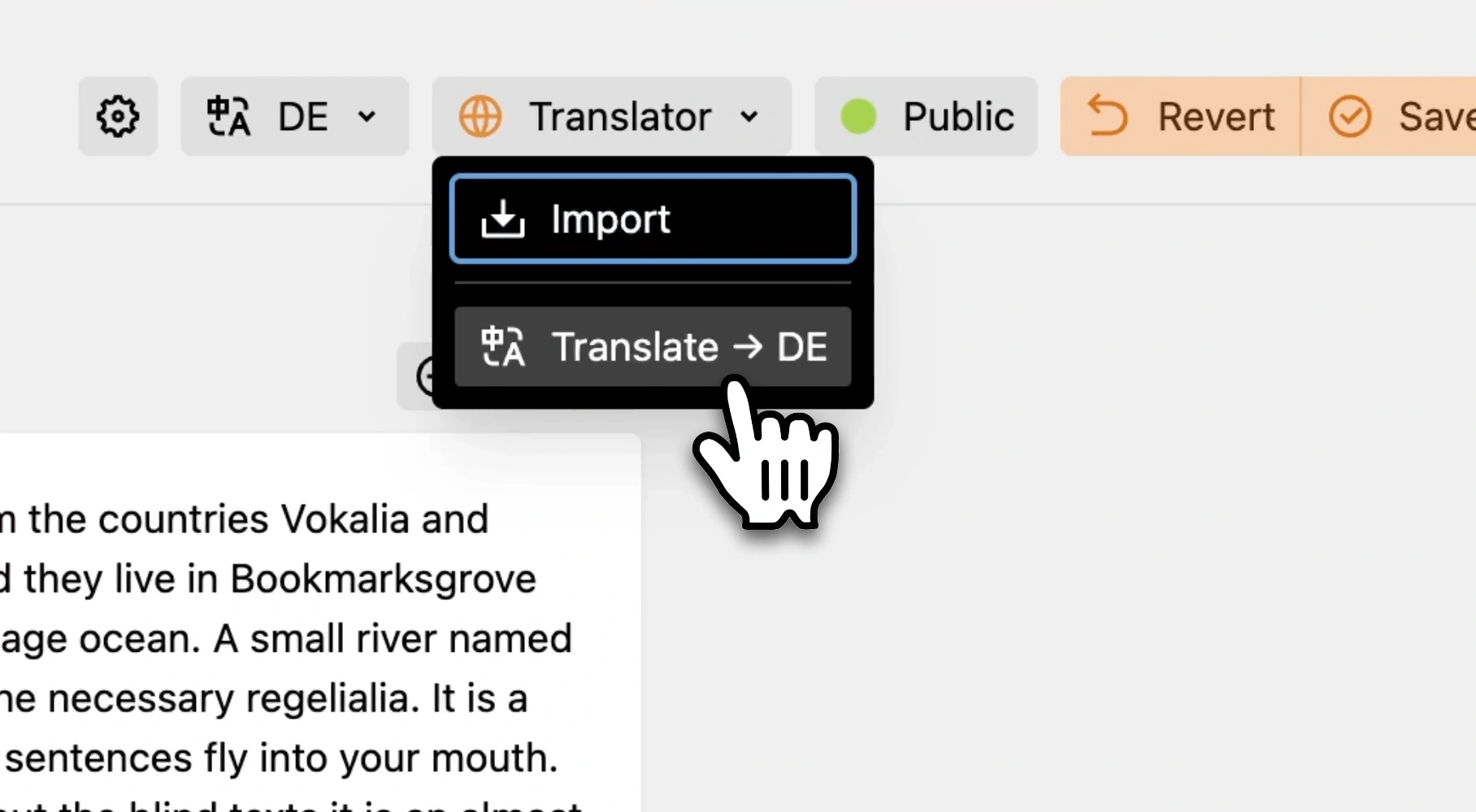
AI-assisted translation plugins are available for content management systems such as Kirby and Statamic, where you can choose your own AI service provider, such as DeepL, Claude, ChatGPT, Gemini, or Mistral. With these plugins, the translation process works as follows: you open a page or article in the admin panel, select the target language, and click translate. The plugin produces the translation directly into the correct language version, in the correct fields. You don't need to copy text into a separate translation tool, reformat it, or worry about the translation ending up in the right place on the site. A process that previously could take hours per page now takes just a few minutes.
AI translations require proofreading
Although AI translations are often good, they are not error-free. AI has a tendency to make mistakes that a human translator would not make. For example, the association's name, place names, project names, or other proper nouns may be translated even though they should remain in their original form. Specialised terms can also be translated incorrectly or imprecisely, especially if they belong to domain-specific vocabulary that is not in common use.
For this reason, it is important that every AI-generated translation is proofread before publication. For the first translations, proofreading requires the most attention, as this is when you establish the site's terminology and style for that language and that AI service. Once the groundwork is in place, translating and checking new articles or pages goes more quickly.
This also brings an important practical piece of advice: it's not worth translating pages into languages that no one in your organisation speaks. It is reasonable to expect that you will receive enquiries in every language your content is available in. If you cannot serve these enquiries in that language, the translation creates expectations you cannot meet.
Multilingualism is an investment in visibility
A properly implemented multilingual website is not merely a courtesy to non-native-speaking visitors — it is an investment in the association's visibility. Each language version is an independent entity that can rank in search results in its own language. An association that operates in, for example, a bilingual region or engages in international collaboration reaches a significantly wider audience with a multilingual site than with a single translation page.
Thanks to AI, this no longer requires disproportionate resources. It's a matter of choosing the right tool and incorporating a small extra step into the publication process.
If your association's website multilingualism needs updating, or if you'd like to find out how AI-assisted translation would work for your site, get in touch and let's discuss it further.