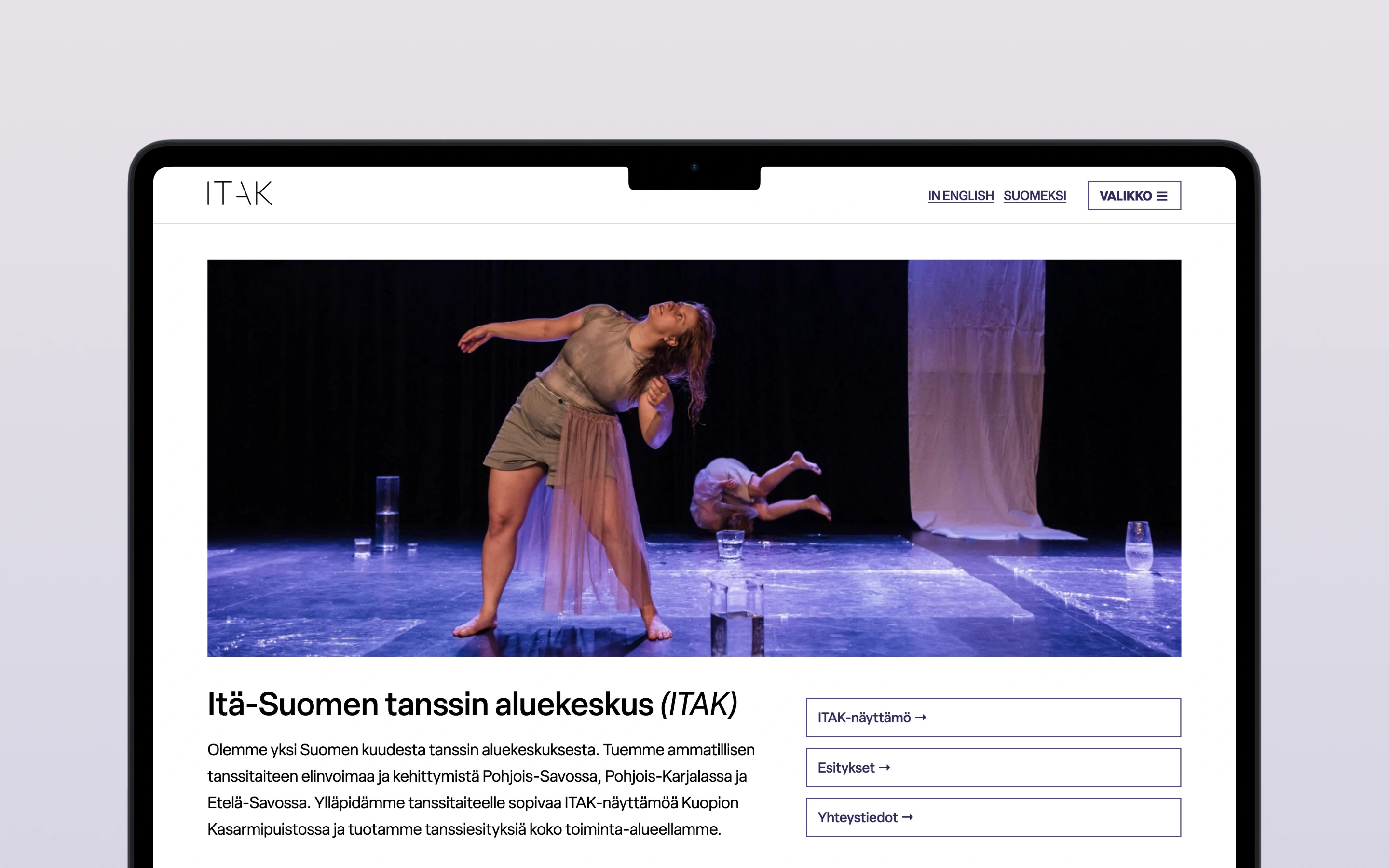
The East Finland Dance Regional Centre (ITAK) promotes accessibility in dance across eastern Finland, but their old website fell well short of that mission. Last updated in 2020, the site was difficult to maintain, clunky on mobile devices, and had several accessibility issues that violated WCAG 2.2 guidelines.
The accessibility issues were wide-ranging: colour contrasts fell below WCAG minimum requirements, and the semantic HTML was poorly structured. On some pages the h1-level heading was missing entirely, and many images lacked descriptive alt text.
The goals for the new website were clear:
- fix the accessibility issues and meet WCAG 2.2 Level A and AA requirements
- make the site easy for the client to update
- make the site work well on mobile devices
- migrate the large news and performance archives from the old site
- build a bilingual site (Finnish and English)
- improve the organisation's grant application process
Design and accessibility hand in hand
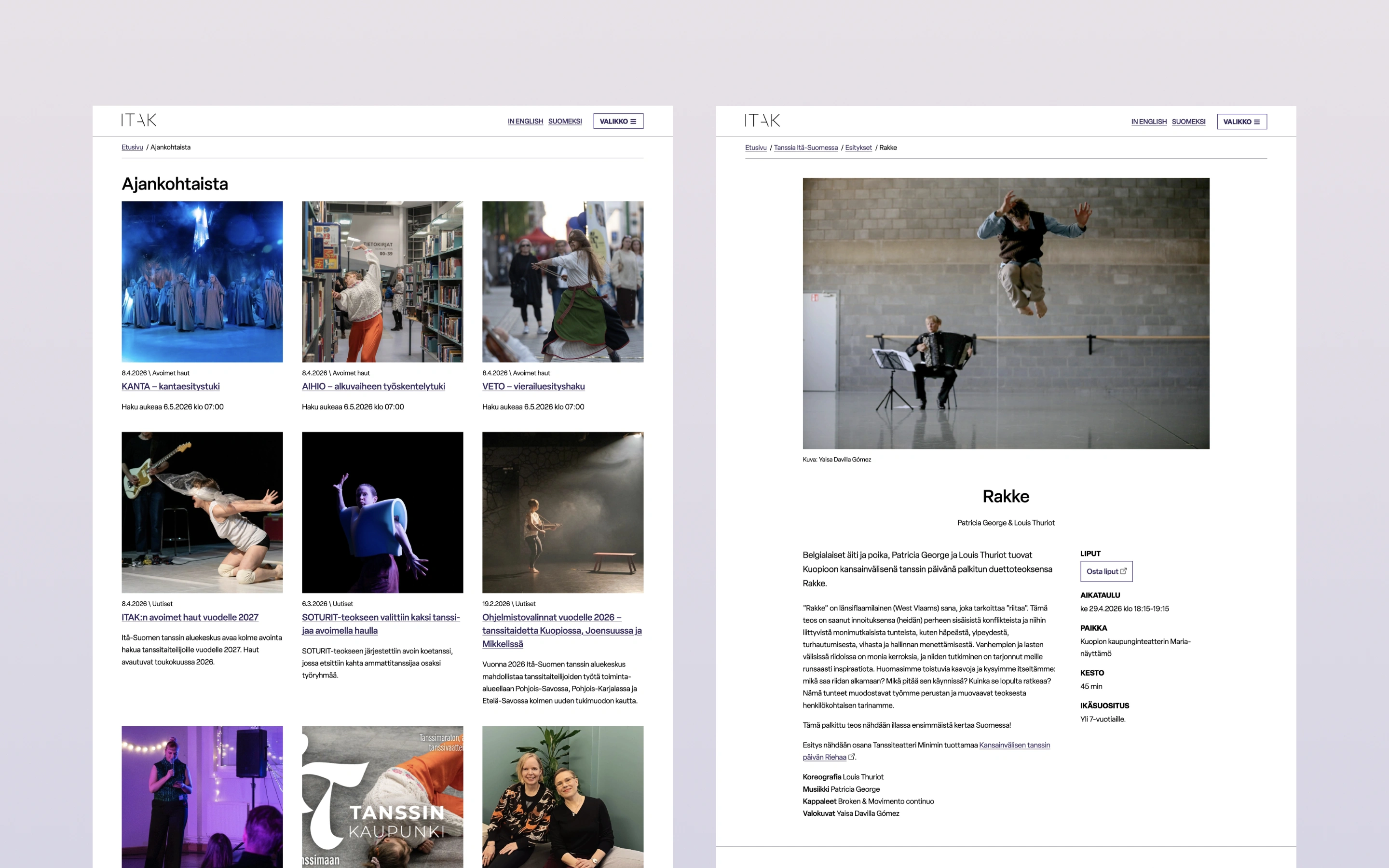
I built the visual design of the new site in line with the organisation's graphic guidelines. The new layout gives content clear structure, helping both readability and findability. Alongside the main colours (black and white), I used the organisation's range of violet shades and mint green throughout the site. These colour choices allowed me to resolve the contrast issues from the old site with ease.
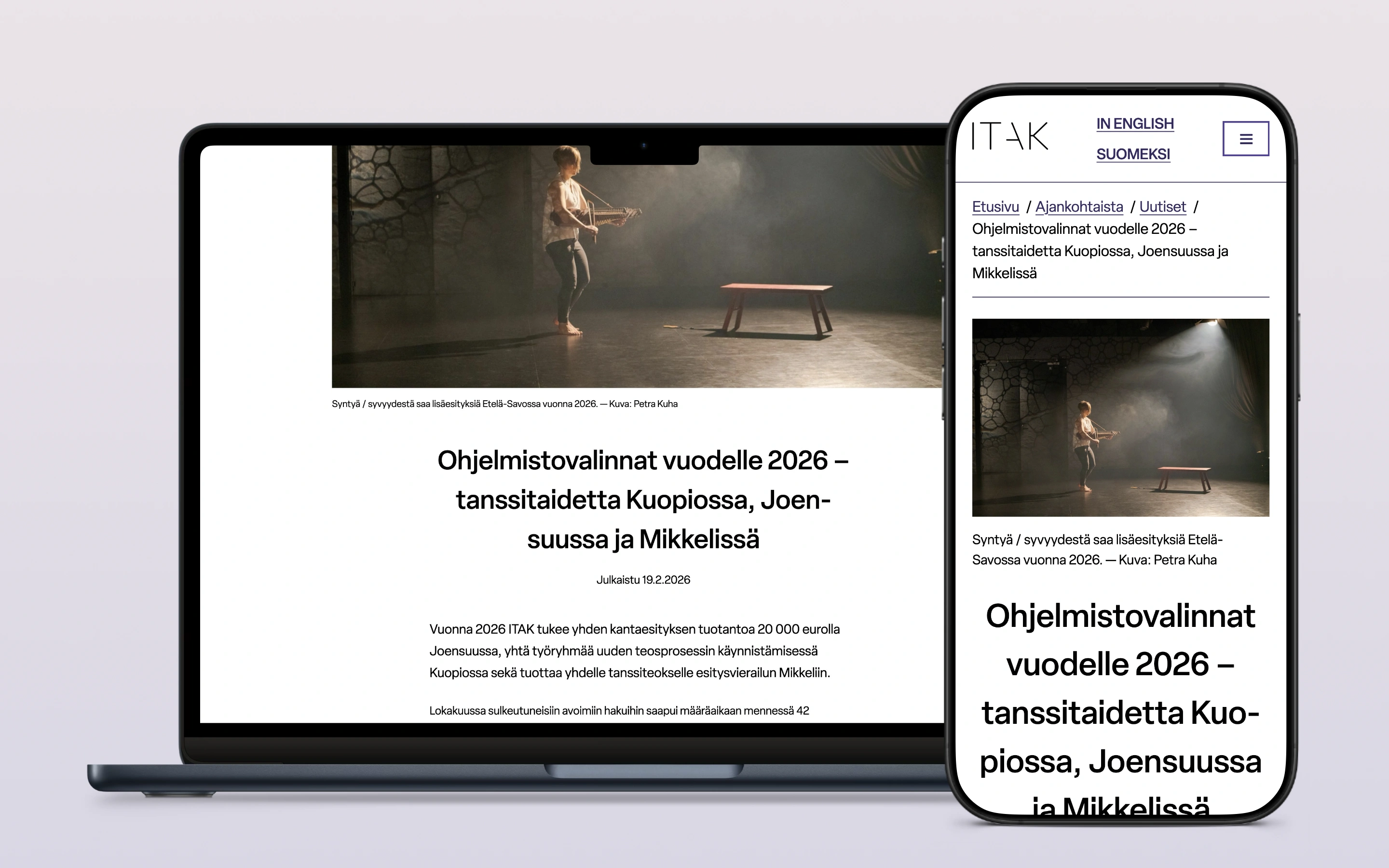
When designing the navigation, I settled on an approach that delivers a consistent experience on both desktop and mobile. The site has a deep page structure, with several subpages carrying key content. Rather than using multiple individual dropdown menus, opening the navigation reveals all top-level and subpages at once, and they remain visible no matter where the cursor moves on the page. This means that even users with motor difficulties — such as hand tremors — can take their time selecting the page they need. Despite being housed behind a button, the navigation is fully operable by keyboard alone.
Throughout the development phase I tested the site regularly with accessibility testing tools. Towards the end of the project I also tested it in collaboration with an accessibility expert with visual impairment, which gave me valuable insight into the real-world user experience.
Automated content migration and new integrations
The new site uses Kirby as its content management system. I chose Kirby for its intuitive editing experience and performance, and it handles bilingual content management effortlessly. I also built a dedicated view for writing and managing image alt texts using a custom plugin, making it easy for the client to add alt text to every image consistently.
There was a significant amount of content to move: both the news and performance archives from the old site contained several hundred individual entries each. Entering all of this by hand would have been unreasonably time-consuming, so I built an automated tool that converted the old site's content to the Kirby platform. As a result, all historical content is available on the new site without a single entry having to be typed in manually.
I also built an integration with Microsoft OneDrive. ITAK distributes grants to support dance art, and their site has several grant application forms. The integration means that applications submitted through the forms go directly into the organisation's own OneDrive, eliminating the need to manually copy data or search through email threads. Because application data stays within the organisation's own systems rather than spreading across third-party services or inboxes, managing personal data in compliance with GDPR is also considerably more straightforward.
The result is a modern, accessible and easy-to-use website that serves both ITAK's staff and their wide network of partners in the dance world.
"Carrying out the website redesign with Lauri was smooth and pleasant. Throughout the process, we received valuable ideas and insights from Lauri regarding the site's structure, content, and development. We especially appreciated Lauri's promptness in responding to issues and his enthusiasm for solving seemingly difficult problems in the way that best served us. We are very pleased with the end result!"
–Alli Mattila, Communications Specialist, Tanssitaiteen Tuki ry